How does SWIFT work when you send money from Nairobi to India?
· 6 min read
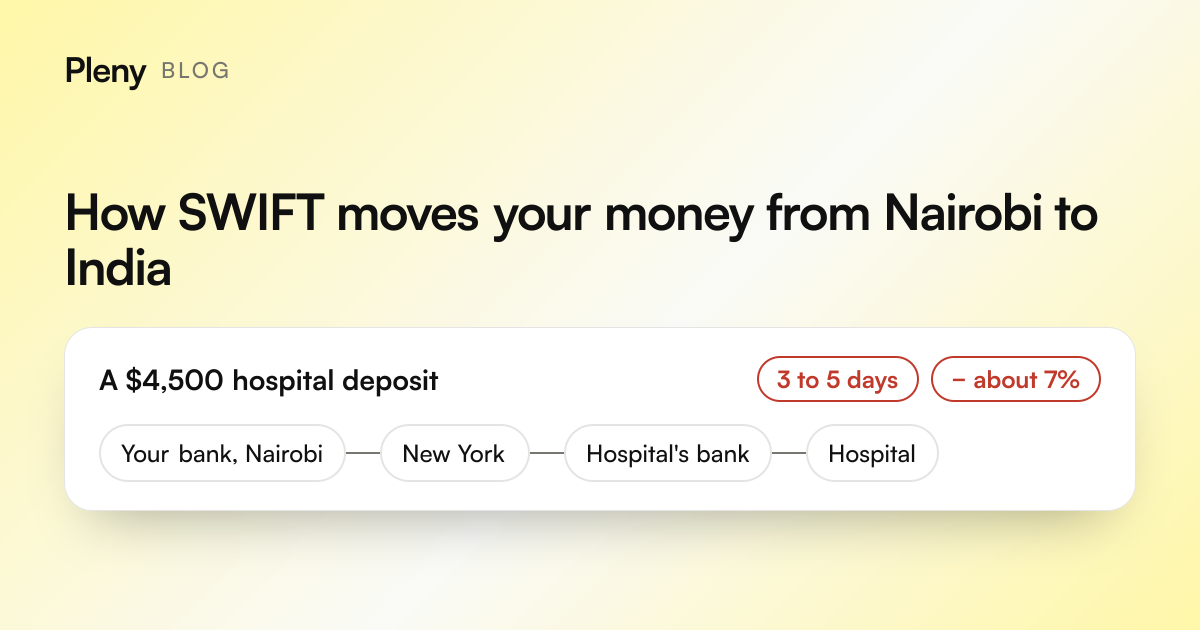
"Not only did I lose 8% in fees, my cancer treatment was also delayed by five days."
That's Tesh, a patient from Kenya, on paying his hospital in India by bank transfer. Most families pay the same way, and most never see what happens to the money between Nairobi and India. Here it is, in pictures, with what to do so your money arrives in full and on time.
The short version
- SWIFT sends a message, not money. The money takes a longer road, through a bank in New York.
- It usually takes 3 to 5 working days, and at least three banks handle it.
- About 7% disappears on the way, mostly in exchange rates you never see on a receipt.
- Four habits prevent most problems: choose OUR charges, copy the hospital's account name exactly, put the patient's name, hospital ID (UHID) and passport number in the reference, and keep the UETR.
What is SWIFT?
SWIFT is the network more than 11,000 banks use to send each other payment instructions. The instruction crosses the world in seconds; the money doesn't travel with it.
What SWIFT does
The message flies. The money takes the long road.
The SWIFT message
Seconds"Pay $4,500 to this account, for this patient."
The money
3 to 5 daysMoved account to account, checked at every bank, a share taken on the way.
Your bank in Nairobi has no account at the hospital's bank in India. So the dollars go through a bank both of them use, usually a big one in New York, which bankers call a correspondent bank. Every stop on that road is a bank that checks the payment, works to its own hours, and can take a share.
Each bank on the network has a SWIFT code, and it's worth knowing how to read one, because it's the quickest check on the details a hospital sends you.
Reading a SWIFT code
Look at the 5th and 6th letters: they are the country.
Every bank has a SWIFT code, its address for international payments. You'll find the hospital's bank's code in the bank details the hospital sends you.
KEa bank in Kenya: yours
INa bank in India: the hospital's
USa bank in the US: the one in the middle
Follow one $4,500 deposit
Suppose your family is paying a $4,500 deposit for surgery in India from a bank account in Nairobi. Here's the trip it takes.
One $4,500 hospital deposit from Nairobi, bank by bank
Now at: You
Working days
0
Still in the payment
$4,500
You
Nairobi
Pay the shilling value of $4,500 at your bank
Your bank
Nairobi
Turns shillings into dollars, sends the SWIFT message
Missed the day's cut-off− $194 in the rate, $15 feeCorrespondent bank
New York
Moves the dollars to the Indian bank's account there
Compliance check, new time zone− $20 feeHospital's bank
India
Checks it, turns dollars into rupees
Held for a name check− $85 in the rateHospital
India
Matches the credit to the patient, tells the ward
Who is this from?
At every stop one of three things happens: the money waits, a bank checks it, or a bank keeps a share. By the time the hospital's finance team matches it to the patient, five working days have gone and $4,186 is left.
Where does the 7% go?
Of the $314 lost on the way, most goes into two exchange rates. Your bank turns shillings into dollars at a rate worse than the market's, and the hospital's bank turns those dollars into rupees at another one.
Where the money goes
$314 of a $4,500 deposit never reaches the hospital
− $314, about 7%
Shillings to dollars · Your bank's exchange rate, in Kenya
$194
Dollars to rupees · The hospital's bank's rate, in India
$85
Correspondent fee · The bank in New York
$20
Sending fee · Your bank, in Kenya
$15
Neither rate shows up as a fee, which is why the $194 at your end is the biggest charge on the transfer and the one you're least likely to notice. These are typical figures, not any one bank's.
OUR, SHA or BEN: which should I choose?
Choose OUR. The transfer form has a box asking who pays the bank fees, and for a hospital bill it matters more than it looks.
The charges box
Paying a $4,500 bill: what the hospital receives
You pay all the bank fees
$4,500
✓ Bill covered
Fees shared; the middle bank takes its fee from the payment
$4,480
$20 short: the bill shows unpaid
The hospital pays every fee, yours included
$4,465
$35 short: the bill shows unpaid
With SHA, the bank in the middle takes its fee out of your payment, so the hospital's system shows the bill $20 short. Then the ward asks for the difference, and you're back at the bank sending $20 with a fresh set of fees. OUR covers the fees but not the exchange rates, and now and then a middle bank deducts anyway, so ask the hospital to confirm what arrived.
Why does it take 3 to 5 days?
The message is quick; SWIFT's own figures say most tracked payments reach the receiving bank within an hour. The days go on everything around it: three banks, three time zones, three countries' holidays.
Why it takes days
The same Friday afternoon, three banks, three clocks
Nairobi
Fri 3:00 pm
You send the money
Bank open
New York
Fri 7:00 am
The bank in the middle is just opening
Opening
India
Fri 5:30 pm
Banks closing for the weekend
Back on Monday
Send on a Friday afternoon and New York is just opening while India's banks are closing for the weekend. Add a daily cut-off at each bank, a compliance check at each bank, and a holiday anywhere on the route (Jamhuri Day, Thanksgiving, Diwali), and five days is normal. If one bank has a question, say the account name doesn't quite match, it can hold the payment for days while it writes back to ask.
How do I track my payment?
Ask your bank for the SWIFT copy and the UETR the moment the money goes. Your bank can tell you the payment left, and not much more; these two let the hospital's bank find it.
Ask your bank for this
Your SWIFT copy, and the one line that finds your money
Once your bank has sent the money, ask it for a confirmation of the payment, called the SWIFT copy. It looks something like this.
SWIFT payment confirmation (MT103)
SAMPLE- Date
- Friday, 13 November
- Amount
- USD 4,500.00
- Charges
- OUR
- Beneficiary
- The hospital, as named on its account
- Beneficiary bank
- ABCDINBBXXX
- Reference
- Patient name + UHID + passport no.
- UETR
- 3f2b8c1e-7a4d-4c9b-9e21-5d6a0f8b1c47
The whole page is your proof of payment. Send it to the hospital.
The UETR lets any bank on the route see where the money is right now.
Many bank staff still call the SWIFT copy an MT103, after the message format banks used for decades. If the hospital says nothing has arrived, send them the UETR: their bank can use it to see exactly which bank is holding your money.
How do I fill in the transfer form?
To send money abroad, your bank gives you an international transfer form to fill in, at the branch or in its app (some banks call it a TT or outward remittance form). The hospital sends you its bank details, usually on its invoice or a letter, and you copy them into the form. Six boxes on it decide whether the money arrives on time and in full; most delays and short payments start here.
Before you send
Your bank's international transfer form, filled in right
To send money abroad, your bank in Kenya asks you to fill in this form, at the branch or in its app. You copy the boxes from the hospital's bank details, which it sends on its invoice or a letter.
Beneficiary name
Exactly as on the hospital’s letter
1Often the company’s legal name, not the name on the building.
Account number
From the hospital’s invoice
2Ask for the details in writing, never only by phone.
Hospital's bank SWIFT code
ABCDINBBXXX
3Check the 5th and 6th letters are IN: that means India.
Intermediary bank (if listed)
EFGHUS33
4US means the bank in New York. Leave it empty if the hospital gives none.
Payment reference
Patient name + UHID + passport no.
5In this order. UHID is the patient's hospital ID; with all three, the hospital matches your money to the right patient.
Charges
OUR
6So the full amount reaches the bill.
A few more things. Every bank sets its own limit on how much you can send abroad, and on a big bill it may not have enough dollars that day, so ask yours about both well before the hospital needs the money. Above about $10,000, your bank will also ask for supporting documents, such as the hospital's invoice or estimate. And send early in the week, away from public holidays in Kenya, the US or India.
Is there a faster way?
We started Pleny because of stories like Tesh's. You pay in shillings, by M-Pesa or Kenyan bank transfer, and family can add to the same payment. Our licensed partner brings the money into India, and the hospital is credited in the patient's name.
Or skip the chain
The same $4,500 deposit, two ways
Planning treatment in India? Tap the chat button on this page to talk to our team, or message us on WhatsApp.
Frequently asked questions
How long does a SWIFT transfer from Kenya to India take?
Usually 3 to 5 working days, sometimes longer. Cut-off times, weekends, holidays in Kenya, the US or India, and a compliance check at each bank all add time.
What is a SWIFT code?
An 8 or 11 character code that identifies a bank on the SWIFT network. The 5th and 6th characters are the country: KE for a Kenyan bank, IN for an Indian one.
What is an MT103?
The confirmation of an international bank payment, named after the message format banks used for decades. Banks moved to a newer format, ISO 20022, in November 2025, but most still call the confirmation an MT103 or a SWIFT copy. It's your proof the money was sent.
What is a UETR?
A 36-character reference that stays with a SWIFT payment through every bank on its route. Banks on SWIFT gpi, the network's tracking service, can use it to see where the payment is.
Why did the hospital receive less than I sent?
Usually because a bank in the middle took its fee out of the payment, which happens when the charges are set to SHA or BEN. The exchange rate at each end also takes a share that never shows up as a fee.
Is there a limit on how much I can send from Kenya to India?
Yes, in practice. Every bank sets its own limit on outward transfers, and banks can run short of dollars for a large amount, so ask yours before you need to send. Above about $10,000, your bank will also ask for supporting documents, such as the hospital's invoice.
Paying a hospital in India from Kenya?
Talk to Janet, our Kenya lead. Pay in shillings by M-Pesa or bank transfer, and the hospital is credited within a few hours.